
July 17, 2026
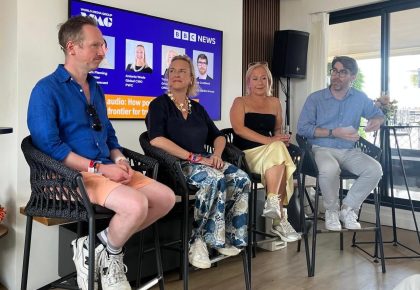
Trust was one of the recurring themes at this year’s Cannes Lions. World Media Group teamed up with BBC Studios for a panel discussing the role trusted media plays in building global brands. WMG CEO Jamie Credland chaired the session with Adam Fleming, presenter of the BBC’s Newscast, Antonia Wade, CMO at PwC, and Tatiana-Vivienne Jouanneau, Global Brand Chief Officer at Allwyn. The panellists discussed what trust really means for marketers, why audio has become such a powerful medium for building it, and what we can learn from the ancient ritual of telling stories around a campfire.
Trust is the ultimate currency
Credland opened by inviting Wade and Jouanneau to reflect on how trust functions within their very different businesses. For Jouanneau, whose background spans consumer-facing entertainment and gaming, trust is not simply a marketing message; it’s the foundation that everything else depends on.
“For brands and principles, trust is a social capital,” she said, “but for the business I’m coming from, trust is the ultimate currency.” Jouanneau explained that trust determines whether consumers will play a game, whether governments will grant a licence and whether customers will adopt new innovations. She also noted that sustained trust generates more commercial value than one-off moments of excitement: “Trustworthy participation brings much more than a jackpot because it’s more like sustained trust for the brand.”
Wade approached trust from the perspective of professional services, noting that PwC has always been in what she called “the trust game” since one of its founders invented the modern audit to address information asymmetry between businesses and shareholders. Wade cited the writer Rachel Botsman’s definition: “Trust is a confident relationship with the unknown.” In B2B buying, where decisions often involve multiple stakeholders and carry significant risk for those making them, trust frequently becomes the one thing a buying group can agree on.
When Credland asked whether AI and LLMs might eventually take over B2B decision-making, Wade was sceptical: “I can’t really see it going into an LLM. If anything, we’ve seen the buying cycles become more complicated, become longer, become more multi-channel.”
The importance of impartiality
Fleming, joining fresh from a news cycle that had seen the UK Prime Minister resign the day before, offered a personal illustration of what trust in journalism means. He described being recognised on the London Underground by a man who had first encountered the BBC while in prison. Through prison radio, the man had discovered BBC content and, without initially understanding the concept of editorial impartiality, had simply found it different from everything else he was hearing.
“He hadn’t realised that the main point about the BBC is that it’s impartial and objective,” Fleming said. “And now every morning he listens to the Today programme in the morning and watches Newscast on YouTube in the evening.” The story, Fleming reflected, was a reminder not to take impartiality for granted: “We sometimes forget that it’s quite a good selling point and people don’t even realise it. So, it’s constantly reminding ourselves and other people that our unique selling point in this landscape is that we’re impartial, we leave our opinions at the door.”
He went on to describe the Newscast format itself, built around good storytellers sitting down to recount the story they have been working on that day, as being both simple and highly adaptable. On the day the Prime Minister resigned, the people telling the story were the journalists who had been in Downing Street. On another day, it might be a correspondent reporting on international diplomacy talks in Switzerland. “The model is very, very simple,” he said, “and we rely on having an organisation of great storytellers who can just come and tell us about their work.”
The campfire analogy
Reflecting on what makes podcasts such a distinctive medium for storytelling, Jouanneau described them as “campfire stories through headphones.” The analogy, she explained, captures something essential about why audio builds trust in a way other formats struggle to match: it is intimate, voluntary and communal without losing its one-to-one quality.
Jouanneau also outlined the metrics she uses to judge a great podcast: repeat listeners, high completion rates and word-of-mouth sharing, as natural extensions of the same logic: “The final thing for me, which really is the signal of trust, is people being able to re-tell the story: “You can’t believe what I heard yesterday!’ And for me, these are all great signals of a great podcast, which transfers trusted news.”
Fleming seized on the metaphor to describe one of his most memorable Newscast episodes, recorded the night the late Queen Elizabeth II died. Wanting to mark the moment in a way that felt authentic rather than formulaic, he invited veteran BBC journalist Jim Naughtie, who had spent 20 years updating the Queen’s obituary, into the studio to simply tell his story.
As the evening grew dark and drizzly outside the studio windows, Fleming said he found himself transported. “I felt I was sat round a campfire down in the valley from Balmoral, listening to almost a friend of the Queen talking about what her death meant to the country.” It was, he said, “an amazing example of what we do every day – a great storyteller, using their expertise and sharing it with the audience.”
“While we talk about podcasts as a fairly new medium,” Credland said, “sitting around a campfire is possibly the oldest medium for communication, fundamental to what we do as human beings.”
Podcasts for B2B audiences
Wade drew an alternative version of the campfire image for professional services audiences describing it as less a roaring communal fire and the early days of feudal villages where not everyone is invited. Thought leadership content, she explained, has always worked well when senior decision-makers have the mental space to engage with it, and podcasts have extended that window considerably:
“You can listen to it in the gym, you can listen to it on a commute. There are these periods where your daily life and your work life can happily coexist, and that’s not true for all media.”
Wade also highlighted the format’s ability to represent an audience back to itself; to ask the questions a reader might want to put to a piece of thought leadership, creating a sense of dialogue that written content rarely achieves. PwC uses podcasts both for external audiences and internally, she added, finding that the format helps reduce hierarchical distance and encourages more candid exchanges between senior leaders and junior employees.
What doesn’t work
Credland finished by asking the panel to reflect upon podcast formats and approaches that had fallen flat. Wade cautioned against over-simplifying technical content in the belief that the podcast format demands it. “If you’re going through the effort of listening to a 20 or 30 – minute podcast, you probably really do want to understand. You want it to be highly technical.”
Fleming offered a personal confession, recalling a short-lived segment called the “Newscast of thousands” – a running tally of news stories with numbers in them that quickly became untenable when the numbers involved real tragedies. “Sometimes we think of a gimmick just because we’re all told to be really creative. Sometimes just stick to what you do best.”
Jouanneau returned one final time to the campfire analogy: the moment trust breaks down, she suggested, is the moment a brand forgets what people gathered to hear in the first place. “The moment marketers start looking at it as a media channel where you have to push and sell, and suddenly start self-advertising, that’s really not what you came for.”
It was a fitting note on which to close a session and a reminder that trust, in audio as in everything else, is built slowly, broken quickly and always more powerful when it feels least like a transaction.