
July 16, 2026
The world is in a state of flux right now. Unprecedented change, combined with multiple crises, is everywhere a global marketer looks. From geopolitical instability and war, through to the unpredictable impacts of AI on the business landscape, everything seems to be changing, all at once.
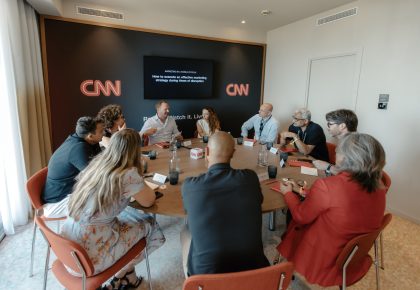
This was the context for the CNN roundtable, ‘Marketing in a world of flux – how to execute an effective marketing strategy during times of disruption’, hosted during the Cannes Lions Festival of Creativity. The roundtable consisted of a group of 10 marketers from around the world, representing different industries, coming together to share their experiences of navigating disruption. And there was widespread agreement that, while there is currently disruption on an unprecedented scale, there are also all kinds of new opportunities for businesses to disrupt the status quo, and ultimately grow.
Disruption Everywhere
The conversation started with an immediate raising of the alarm from Elda Choucair, CEO, Omnicom Media MENA, highlighting that within the MENA region there was only one crisis worth talking about – the Iran war, its spill over into other countries, and the impact this is having both on global supply chains and the regional economy. ‘We are having our 9/11 moment,’ she said.
There was an acknowledgement that even disruption on this scale is temporary, though data quoted by Choucair suggests it would be 40 months to return to normal levels according to a study conducted by Dr. Radford from EMIR Intelligence. And importantly, even though some normality may eventually return, research suggests that only 9% of companies come out the other side of this scale of crisis as outright winners. The others stagnate or disappear.
Despite this level of disruption, the demands for growth show no sign of abating. Nicole German, Global Chief Marketing Officer, Corporate and Institutional Banking at HSBC, highlighted their own data on the subject: ‘Ninety five percent of senior leaders say volatility is just the way of the world now. But many say they still need to grow. That tension — resilience vs. growth vs. transformation — is the defining challenge for large global organisations.’ And these challenges are much harder for large, global corporations than smaller, more nimble competitors.
The search for opportunities
Yet even within this turbulence, many marketers were finding opportunities across the globe. Severine Nubel, Global Brand ID and Advertising Director, Orange Group, highlighted that Africa, as a region, was growing at a phenomenal rate for their business, and encouraged others to take part in this thriving, high energy economy: ‘It’s an energy… it’s really the future of the world.’
Shelley Stewart, Senior Partner and Global Leader, Insights, Reputation & Engagement, at McKinsey described the prospects in terms of the new trade routes and connections that were opening up, between Brazil and India for example. The creation of this new, multi-polar world offers opportunities.
Dimitri Maex, Global Marketing Practice Lead at Accenture Song, was clear that the key here is agility, and building structures that are able to respond at pace. He highlighted changes happening in the Travel and Automotive industries, where consumer demands and supply chain changes have had a huge impact on each. The good news is that AI is acting as a tool to enable faster market research and trend validation, which can now take days instead of months. The challenge remains empowering the organisation to be able to pivot quickly in light of these changing behaviours.
AI as a disruptor
That AI is here to stay was agreed by everyone taking part, but it was when we explored the speed of the disruption AI would provide, and what impact it would have, that the ambiguities of this new technology became clearer.
Abhinav Kumar, Global Chief Marketing & Communications Officer at TCS, highlighted that 98% of companies have experimented with AI in some form. However, only 5% say they’ve deployed it in an advanced way. That deployment gap is incredibly significant. And while to some extent it may even be deliberate, particularly in industries where compliance and security slow down deployment, it does leave the door open for new, AI-native competitors to enter.
However, these opportunities come with associated challenges, particularly for established, large organisations.
Stewart highlighted that, given an AI-native business can now be created faster than ever, incumbency is going to be under threat in many sectors. And this disruption, much like the broader geopolitical changes, will start to play out along national and regional lines.
With the US becoming increasingly involved in controlling the AI chips market through export controls, Kumar highlighted that Japan, China, India (Sarvam — multilingual model), and Europe (Mistral — backed by Airbus, BMW, ASML) are all building their own AI technologies, both to mitigate risk and to compete on the global stage. Much as with the economic disruption, it suggests the technological shift will lead to a multi-polar, more complex environment than we have today.
Marketing strategy in shifting sands
The key to building a marketing strategy in this environment, as Stewart pointed out, was to be absolutely clear on your ‘true north’ and then build ‘multiple paths to get there.’ This might result in additional costs to build resilience, but it was key to building growth in this changing environment.
German shared that what she really wanted from AI was “to give us more time to ‘work the craft’” of marketing.
Partnerships and trust in marketing strategy
With all this technological disruption, all the marketers in the room felt that human connections or involvement are going to become more valuable, rather than less. Maja Neable, Global Chief Marketing Officer, TD Bank cited their tagline of being the ‘more human’ bank, and that all customers, whatever their wealth level, preferred content that focused on human stories (rather than specific product benefits for example).
Kumar built on this, highlighting that TCS declined the sponsorship of a new, high-tech sports opportunity, because it lacked any human involvement. People love sports because of the human stories and drama, and without that, the engagement simply isn’t there. So how can marketers build trust, and what is the role of media partnerships in that?
Rob Bradley, GSVP, International Digital Advertising Strategy and Operations, CNN International Commercial and WBD, who chaired the discussion, highlighted that the creator economy is booming but there’s also an echo chamber, a huge amount of synthetic AI content and a threat against journalism and news organizations at a time when trust is everything. “Certainly, when there’s breaking news, like the conflict in the Middle East, people swarm to CNN because trust really matters when you want to verify something – and that’s important whether it’s from CNN or another trusted news organization.” Of course, influencers do not operate with the same editorial processes that the large, established media brands do. In today’s turbulent market, Bradley highlighted that the need for an independent, trusted information source is greater than ever.
While there was broad agreement in this approach, and the split between influencers and larger media organisations, the perceived editorial bias or perspective of media institutions was causing issues internally, creating a new internal challenge for marketers to navigate. Stewart pointed out that, with 120 offices in 68 countries and 35,000 employees, the political perspectives of the staff across the organisation are naturally diverse. This can lead people to question the choice of any individual broadcaster or publisher, or to request that an opposing perspective is given equal investment. With these challenges, sometimes the easiest approach is to filter toward content that’s ‘down the fairway’ — less controversial, more reputationally safe.
I offered an additional perspective from WMG, regarding the ROI for marketers on investment in news. While there will always be arguments on the specifics of any editorial position, the data on the value for advertisers is clear. News is safe for brands, consumers can differentiate between editorial and advertising content, and people are turning to news sources to explain the world in record numbers. However, this message is not reaching marketers as it should, making it harder to defend the economic argument for investing in news.
Navin Rammohan, SVP and Segment Head, Marketing, Infosys, gave his own perspective, saying that they were now investing in 4-5 media partnerships, rather than just one a year ago. Multiple partnerships go some way to avoiding accusations of bias, and he was clear that the focus was on content partnerships rather than display advertising. Taking this approach had delivered measurable uplift for Infosys in relevant awareness, not just general visibility.
At the end of the conversation, we went around the table to hear each person’s key takeaway from the week in Cannes. It was striking that trust, inspiration, and human connections came up again and again. Even in a world of unprecedented disruption and technological change, it seems that the marketers around the table were still craving very human things – stories, connections and relationships. Perhaps this can give us all some inspiration on the tools that marketers will need to successfully navigate this world of flux.