
November 4, 2026
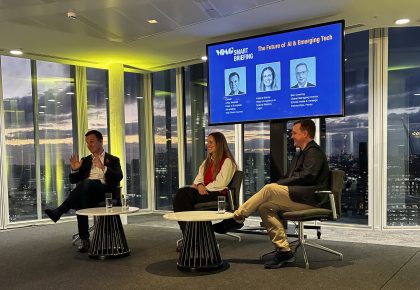
Last night, the World Media Group hosted a panel exploring the Future of AI and what it means for premium publishers. Katrina Bishop, Head of Audience & Special Reports at CNBC and Ben Downing, Global Managing Director, Ethical Media & Strategic Partnerships at Havas Media Group, joined us for the discussion, chaired by Chris Woodall, Head of European Advertising at the Wall Street Journal.
The panel looked at how AI is affecting different parts of the media industry, from the newsroom to audiences and advertising. The sentiment from our panellists was optimistic, fuelled by a sense that trusted journalism is becoming more and more valuable in the age of AI.
AI does the grunt work, journalists find the news
Woodall opened the conversation with an example from the Wall Street Journal newsroom of an investigation into toxic fumes on passenger planes. Reporters used AI to work through millions of federal aviation reports and find patterns nobody had seen before. “That would have been impossible to do without that technology.” Woodall said, “That’s how we found out what the story was, and we published an exclusive.” The Wall Street Journal also published a second piece explaining the model and how the team did the reporting, demonstrating transparency and human oversight: “Every story is reported by journalists and is reviewed by editors,” he said.
Bishop described similar uses of AI at CNBC, particularly for business and financial news, where they use it to analyse earnings reports, to pick out themes from multiple CEO interviews over an earnings period, or to find specialist sources. There, too, it requires human oversight: “The answers would be pretty poor if you didn’t go in with a really in-depth knowledge,” Bishop said, “I’d be worried if you didn’t have a journalist who knows what they’re doing running it.”
Her best example came from a CNBC tech reporter’s interview with Nvidia CEO Jensen Huang. The reporter had prepared his research and asked AI to suggest questions, in case it came up with something he hadn’t already thought of. In the end, he didn’t use any of the AI suggestions and the interview produced several solid news articles and viral clips. “Actually, AI couldn’t deliver the news-making question,” Bishop said. Woodall agreed: “AI can only report on what has already been reported. It’s still down to the journalists to go out and break the news.”
Audiences are noticing and tiring of AI
That said, publishers are still facing extreme pressure. Bishop cited Chartbeat analysis showing traffic is down by 40% year-on-year for the publishers measured by Chartbeat. AI summaries may not be the only cause, but they’re “certainly not helping” she said.
Consumers are also more aware of AI than the industry might think. Downing pointed to Havas research covering 2,100 brand journeys across seven markets, which found that across all age groups, 56% say AI used by brands can feel misleading, and around half think it makes brands look, feel or sound the same. Only 29% had had a positive AI brand experience that felt human.
There are signs that audiences are starting to value all things human again. Woodall pointed out that many brands have deliberately avoided AI in this year’s Christmas ads. Bishop told an anecdote that summed up the mood perfectly. She saw a poster for her local village’s pre-Christmas fair that had clearly been created in Word. It was the first non-AI village poster she’d seen in a year, and so refreshing that it made her want to go.
Lessons from the programmatic era
Downing warned that the industry risks repeating the mistakes of programmatic: “It was seen as this wonderful panacea for monetisation,” he said, “and arguably… ruined a lot of experiences.” He also pointed out the pivot to video and the challenges associated with it when platforms changed their view metrics. “Premium publishers, those that could harvest long attention and keep it, were able to resist some of that,” he said.
He said the lesson premium publishers should take away is not to “allow intermediary technology to disrupt your value.” Where AI differs from programmatic, is in what Downing described as a new “surface of attention”, closer to a new type of media, with different decisions to make.
Bishop agreed that publishers have been burnt by trying to follow platforms before, from keyword-stuffed SEO headlines to pulling the rug from under news publishers. “I hope what this means is that news publishers now realise the value of their own content and resist some of that.” she said.
GEO, reputation and measurement
The panel went on to talk about GEO (generative engine optimisation) and what it means for premium publishers. Bishop said she takes hope from early indications that AI search is “strongly rewarding well-reported, well-sourced, authoritative news”. In the GEO-world, “we’re actually being rewarded for great journalism,” she said.
Downing added that foundation models are being trained on AI-generated information, which in itself is degrading the model, making premium newsroom content “absolute gold”. The fundamentals of SEO haven’t changed, but Woodall said content increasingly has to work for both readers and LLMs. The Wall Street Journal’s talent lab creates videos with real journalists, promoting the faces behind the bylines and producing content that’s both respected by human readers and picked up by AI.
PR and reputation management is also facing new challenges because of GEO. Woodall described clients seeing crises they managed 20 years ago resurfacing in AI citations, and Bishop noted the risks that arise when old stories reappear and are then misreported to disastrous effect. RFPs are also changing, with many already asking how campaigns affect AI citations and GEO. Downing expects those questions will become more structured.
The biggest opportunity for premium publishers may be measurement. Downing pointed to Gartner predicting a major change in measurement driven by AI search, the new “surface of attention.” He sees this as a chance to break with many of the issues dating back to programmatic. If the industry can figure out how to measure AI visibility in query citations through to real commercial impact, Downing says premium publishers have a golden opportunity. “It’s the only place that you have this wonderful audience that pays for you, that spends time with you, and that has human comments that are safe from bots and curators.”
What does 2030 look like?
Woodall ended the panel by asking for one prediction that they’d bet on for 2030. Both panellists were optimistic. “I’m really hoping that we’re going to see a golden era of journalism as the backlash against AI,” Bishop said, with AI handling commoditised news such as press releases or standard earnings write-ups, freeing up journalists to spend more time on original reporting and scoops.
Downing predicted a dramatic increase in the cost of enterprise models, plus more use of open-source models, both of which will benefit businesses that have invested in ‘on premises’ AI. He also expects to see a backlash amongst certain demographics, particularly Gen X and Gen Y, with more conscious digital detoxing becoming a lifestyle choice, making print, analogue and curated offline experiences more important.
He ended on an optimistic note: “If we can learn from some of the things we did in the past, this is an extraordinary moment for premium publishers,” he said. “The future is ours to lose, rather than having already lost.”
 World Media Group