
May 27, 2026
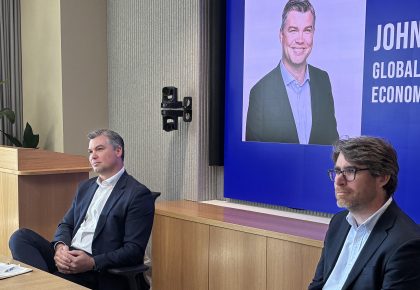
Last week at our Brand Advisory Board (a gathering of senior marketing leaders), WMG CEO Jamie Credland hosted an interactive discussion with John Ferguson, Global Head of Trade and Geopolitics at Economist Enterprise, exploring the current global business outlook. Here are the key takeouts from the conversation.
Caution has become the new normal
Ferguson opened with a frank assessment of business sentiment based on his ongoing conversations: “What I see when I spend time with business leaders is just caution.” He says there’s more hesitation as business leaders stop and question how things are going to land: “It doesn’t mean people are stopping their investments or their campaigns. It just means people are pulling back a little bit, because uncertainty is here again.”
One of our brand leaders put it more starkly, sharing research that suggested something has fundamentally shifted: “Uncertainty has changed to unreliability. The analogy that was made is that if you’re waiting for a bus, you know you might be delayed, but you know a bus is going to come. We’re now in an era where you’ve no idea if the bus is even going to come.”
The ‘world minus one’ strategy
One of the key themes throughout the discussion was what Ferguson described as the “world minus one” approach – the idea that the US now requires an entirely separate strategy from the rest of the world.
“At Economist Enterprise, we talk about a world minus one strategy for businesses. They have to have a [separate] strategy with the US, because the US is on its own unique path. But countries and companies [outside of the US] are trying to work with everyone else in a more constructive way.”
The room immediately recognised this approach in their own businesses. One attendee said they had restructured entirely as a result: “We simply restructured the entire team into two business units. It’s the first time we’ve ever done it because we’ve always been about global. But global doesn’t exist anymore. The considerations are different.”
Another attendee described the operational reality of managing the US differently: “Our activities in Washington have really increased. We’ve never had a base there, but now we have a full budget with a Public Affairs Office there. The conversation and the strategy for America is completely different than most large enterprises now.”
US still open for business
Despite all the doom and gloom, walking away from the US is not an option. As Ferguson explained, “The reality is the US isn’t going anywhere. People will hedge their bets and try to figure out what amount they want to put into the US, but they’re not going anywhere. They’re just going to look at it differently.”
One of the attendees pointed to evidence of continued commitment to the US, including the largest ever UK trade delegation heading to Los Angeles to focus on the creative, tech, digital and AI economies. However, they said they were seeing a lot of companies doing things on a state-by-state basis.
Texas opened its first trade office in the UK a few weeks ago. The state-by-state approach is becoming increasingly common, with one attendee describing how their business now operates: “We have to produce reports by state. We have a permanent team and workstream, and that’s different than I imagined 10 years ago.”
The reverse Trump effect:
Ferguson talked about a reverse Trump effect – meaning that many of Trump’s moves succeed in having the opposite outcome to what was intended. The unexpected upside of global trade disruption is that countries and businesses are finding new partnerships, precisely because of American unpredictability.
“The reverse Trump effect on trade means Europe, Britain and other countries are really now trying to work together to lower tariffs and create partnerships. The EU has done all sorts of trade agreements with India – they call it the mother of all trade deals – and Mercosur out there in Latin America. Trump’s teaching people, holy crap, tariffs are bad.”
He was equally direct about the cost of recent US volatility: “If Mr. Trump had curtailed some of his instincts, we would be living through a huge AI boom in the US economy. Many things that he’s done since he came into power has been damaging for economic growth.”
Japan: Stability as a Competitive Advantage
With so much volatility elsewhere, Ferguson pointed out that Japan remains appealing to businesses: “It’s steady, stable. Despite subdued economic growth, I think that is a relatively positive story right now. What business leaders want is stability and predictability. And that’s because every day, you’re just shocked by all the things happening in certain places. Japan has just a more stable outlook, and again, still a big market.”
Business sentiment is cautiously optimistic
The session reflected a business community that is stressed but not paralysed. When Credland polled the brand leaders in the room on growth expectations, the room was roughly 50/50 on optimism. The dominant themes were adaptation and pragmatism: treating the US as its own distinct strategic territory, finding new partnerships elsewhere and resisting the urge to retreat entirely.
Talking about the longer-term political outlook for the US, Ferguson was optimistic: “Sometimes you have to lose something to know what you’ve got, to then want it back. Over time, I expect some return to a rules-based system from the Americans.”
The question for businesses in the meantime is how to navigate wisely until that moment arrives.