
June 24, 2026
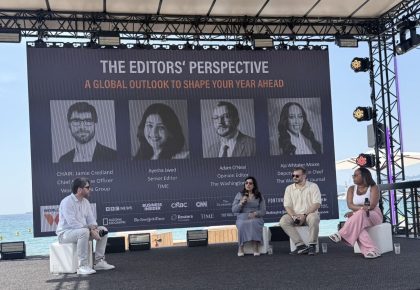
The World Media Group is at Cannes Lions this week. Our first event was our annual Editors’ Perspective at the RTL Ad Alliance beach, where three of the world’s top editors gathered to discuss the state of journalism, the rise of AI and why trusted editorial environments matter more than ever.
Chaired by WMG CEO Jamie Credland, the panel brought together Ayesha Javed, Senior Editor at TIME, Adam O’Neal, Opinion Editor at The Washington Post, and Aja Whitaker-Moore, Deputy Editor-in-Chief at The Wall Street Journal, for a conversation that ranged from breaking news pressures to the difference between a journalist and a creator.
The relentless news cycle
Credland opened by joking that there had been “a lot of news” in the past year, underscored by the announcement just minutes before the session began, that Keir Starmer had stepped down as UK Prime Minister.
All three panellists agreed that the pace and gravity of the news environment had intensified dramatically. O’Neal reflected that in 15 years of journalism he had never experienced a shortage of interesting stories, but what had changed was “the sense of urgency as you have geopolitical crises, political instability and this technological revolution all happening at once.”
Whitaker-Moore agreed “I think a second Trump administration, coupled with an AI revolution, has exhausted us all,” she said, though she noted it had also deepened audience demand. “The depth and breadth of what we’re covering has really increased, and I think there’s reader demand for our expertise in helping figure out and understand all of these kinds of revolutionary moments.”
AI in the newsroom
The conversation moved swiftly to artificial intelligence. Whitaker-Moore, who oversees AI integration at the Wall Street Journal, described a focus on tools that “superpower and supercharge our journalism.” She highlighted the ability to process “hundreds if not thousands of documents” to unlock investigations that “would have taken us months, maybe years, to crack open.” The Wall Street Journal has also introduced a reader-facing product called The Backstory, a tool designed to synthesise complex, ongoing stories for casual readers who want to quickly understand key players, timelines and context for complicated topics.
Whitaker-Moore was equally clear about where the boundaries lie. The value of trusted journalism, she argued, is something “that no robot is ever going to be able to do,” particularly scoops and exclusives plus the expertise across business, finance, economics and geopolitics that The Wall Street Journal has built over more than a century.
Journalists vs creators
When Credland questioned the difference between journalists and creators or influencers, Whitaker-Moore’s answer was unambiguous: “Journalists can be creators, but creators can’t be journalists.” She explained that journalism is a profession with ethics, standards and training, and that maintaining that distinction is essential for rebuilding audience trust. Pointing to the assassination attempt at the White House correspondents’ dinner recently, she noted that “there were a lot of creators on site and there were a lot of journalists on site and there was a lot of misinformation.” Journalists, she said, even when working on social platforms, are “doing it responsibly, they’re doing it factually, and they are doing it within a training and standard in mind that a creator just doesn’t have.”
That said, Whitaker-Moore was enthusiastic about the opportunities social platforms present for younger journalists. “The beauty of it is that you really don’t have to teach a junior journalist TikTok – it’s part of their life.” The expectation, she said, is simply to “be authentic and show your process – how the story is made.”
For O’Neal, the relationship between legacy opinion journalism and the creator world doesn’t have to be an either / or situation. He offered a view on how the Washington Post’s opinion section is engaging with the creator economy. Rather than treating it as a threat, the section has partnered with independent voices who have built significant social followings, helping them meet editorial standards while reaching new audiences. He described one collaboration with an urban design commentator who was going to interview a CEO: “We were able to provide him journalistic advice on how to approach that, and he was able to reach our editorial standards, and also we were able to reach a new audience that never would have been coming to a regular newspaper.”
Trust, fact-checking and legal threats
Javed spoke about the rigorous processes that underpin TIME’s editorial work, including the TIME 100 sector lists, where almost every subject is interviewed, and selection is subject to ongoing scrutiny. “It just comes down to good old-fashioned journalism,” she said, adding that fact-checking is embedded from the earliest stages of a reporter’s career and “really just becomes second nature.”
Whitaker-Moore addressed the growing trend of pre-publication legal threats, describing it plainly as “a tactic for people to use the legal system to prevent great journalism and great stories from being told.” She was clear that it had not changed the Wall Street Journal’s approach, but acknowledged its unfortunate effect elsewhere: “It has a chilling impact at smaller newsrooms and newsrooms that are not as well capitalised to defend against these types of tactics , and that is the intended consequence.”
Why trusted editorial environments remain valuable for brands
Credland drew a direct line between editorial rigour and advertising value. When audiences come to trusted publications, they arrive with an open and trusting attitude, and that context, he argued, is what makes these environments so valuable for brands.
“TIME is somewhat unique in that respect,” Javed noted. “We have incredible access to such a range of people, and then we also have expert analysis from our reporters who have been doing this for years, and all of that helps to build trust, and that can’t be replicated by AI.”
Whitaker-Moore added: “People are really looking to us for trust and information, for expertise, and in chaotic news moments, that’s really what people are searching for – pillars that they can trust, people that they can trust, and brands that they can trust.”
She also pointed to subscriber and engagement growth at the Wall Street Journal as evidence that quality journalism continues to attract and retain audiences.
Looking ahead
The panel closed on an optimistic note, with each editor sharing what they are most excited about in the year ahead. Javed is focused on the forthcoming Time 100 AI list, due to be published at the end of August. O’Neal spoke about using AI to give the opinion section access to reporting at a scale previously out of reach: “To the extent that we can do that as opinion journalists and get new insights, those are things that we’re experimenting and prototyping now.” Whitaker-Moore pointed to video as The Wall Street Journal’s biggest growth priority, describing a commitment to “figuring out how to tell video-first stories in a really beautiful format.”
The overriding message from all three editors was that, in an era of information overload, the fundamentals of journalism – rigorous reporting, fact-checking, editorial standards and the trust they generate – matter more than ever.