
August 19, 2025
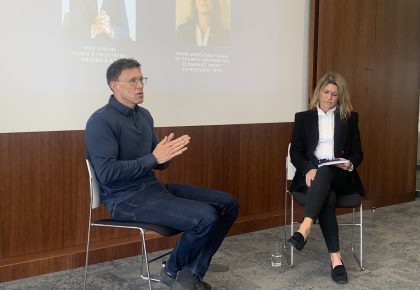
In our third panel at the World Media Group’s Agency Future Leaders event, Ground + Air associate and Wonder partner, Nick Jenkins – a seasoned coach and former media executive – was interviewed by Economist Impact’s Emma Winchurch-Beale on the role of coaching and personal development in helping media professionals, particularly those at mid-level, navigate their careers with confidence and clarity.
The session explored why now, more than ever, personal growth is a necessity not a luxury. Here are Jenkins’ actionable tips and insights from the discussion.
Not just for the C-Suite
While coaching is often misunderstood as a tool reserved for senior leadership, the reality is quite the opposite. Those in the early to mid stages of their career are well-positioned to benefit from coaching because they are delivering, influencing and increasingly expected to lead – often without formal development support.
According to the survey our Future Leaders filled out before the event, only one person had previously worked with a professional coach, highlighting a significant opportunity gap.
Coaching vs. Mentoring: understanding the difference
Jenkins began by explaining the distinction between coaching and mentoring. “Coaching is an approach to personal development rooted in a one-to-one conversation-style dynamic between a coach and a coachee. The idea is that the coach is skilled in creating the right conditions and asking the right questions for the coachee to be able to overcome any obstacles or deliver any outcomes that they want to.”
While coaching is about guiding individuals to discover their own answers, mentoring is more directive, sharing experience and advice. “Mentoring is much more around the transfer of information or wisdom – it’s almost like teaching,” Jenkins said. However, often a relationship with a coach can have mentoring elements and vice versa.
Both are valuable, but serve different purposes For example:
- Coaching is ideal for building self-awareness, navigating career transitions or improving leadership skills.
- Mentoring is well-suited for upskilling in a specific discipline like content marketing or programmatic planning.
Why mid-level talent needs coaching
The conversation uncovered a number of key challenges that mid-level professionals face, including a lack of time and space for development and career uncertainty, despite having ambition.
“I don’t think there’s enough time spent on personal development and reflection and on working ‘on’ the business as opposed to ‘in’ the business.” Jenkins said. Rather than talking about clients, revenue and pitch skills, he would like to see managers spending more time asking ‘Are we an effective team?’ Or, for individuals, thinking about “What does my future look like?” and having the time and space to come up with a plan.
Coaching provides a rare moment to step out of the day-to-day and work on your career, not just in your role.
When to consider coaching
Coaching can be especially valuable at pivotal career moments, such as starting a new role or project, or preparing for a promotion. It can be a useful tool for those wanting to lead more effectively, or can help you if you’re feeling stuck or unsure about next steps. That said, you don’t need a crisis to start coaching.
“Having a growth mindset is one of the things that leads people to coach most frequently,” Jenkins said. “It’s about recognising that we aren’t the finished article.” It’s also not a one-time thing but an ongoing process. Even as a coach himself, Jenkins continues to see other coaches as good practice, for his own development.
Strategic networking beyond Linkedin
Networking is another essential but often overlooked part of professional development. “Looking at networking with a strategic lens is really helpful for career progression,” Jenkins said, “And coaching provides an opportunity to develop how you’re going to approach networking.” He recommends thinking strategically about three types of networks:
- Personal – friends, family, those who give you support on your journey
- Operational – those who help you do your job day-to-day; e.g., colleagues, suppliers
- Strategic – senior contacts, mentors, thought leaders
Jenkins’ advice is to be intentional about networking. “Think ‘Is my operational network where it needs to be? Is my strategic network where it needs to be?’ If there are any gaps, guess what? They’re not going to solve themselves. Have a proactive and strategic approach to growing a network that can help you align where you are now, with where you want to go with your career aspirations.”
Jenkins recommends the CPR approach to networking:
- Curiosity – Be interested rather than interesting; think of different questions to ask beyond the usual “What do you do?”
- Reciprocity – Ask “where can I add value to this relationship?”
- Persistence – If you can’t get hold of someone, don’t give up; try a different angle, see if there’s someone who can introduce you; just keep going.
LinkedIn can be a helpful tool, but face-to-face connections remain irreplaceable, particularly as AI becomes more prevalent. “In five years, you may not know if that’s really your colleague on a Zoom call,” Jenkins said. “The only sure fire way to know is by being in the same room with them and asking questions that put them on the spot.”
How to making coaching happen
If you’re interested in coaching, how do you make it happen? Jenkins explained there are multiple routes:
- Ask your line manager and / or your HR or Learning & Development teams whether coaching is already available
- Explore industry resources such as NABS, which offers free and subsidised support
- Seek referrals to ensure quality, as coaching is currently an unregulated industry.
When pitching coaching to your manager, the key is to link personal growth to business goals. If you can show how coaching will improve strategic alignment, team performance or client outcomes, you’re more likely to receive a positive response.
Invest before you need It
Finally, a recurring message was the importance of proactive development. You may not know exactly why you need a coach, other than you want to create some kind of positive change. “Don’t feel that you have to have all the answers,” Jenkins says. “The purpose of the coaching is to unpack that.”
Jenkins’ advice is to start now. “Position yourself when the going is good, before you need help, so that you’re in a position where you can get it very quickly when your back’s against the wall and you actually need it.”
Whether it’s coaching, mentoring or networking, be proactive – don’t wait until you’re under pressure to start building your future.
Read more top tips from our Future Leaders event: